
Amanita calyptroderma/ calyptrata/ lanei
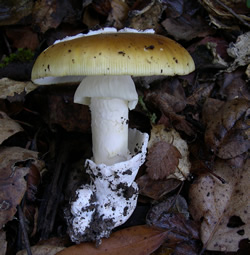
Classic Fall Coccora © photo by Debbie Viess
Latin be damned, just call it the Coccora!
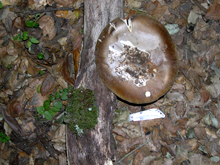
Here in the Bay Area, one of the most beautiful of our early season mushrooms is the distinctive Amanita calyptroderma, or Coccora. These mushrooms can be found growing beneath the handsome, red-barked Madrone and Live Oak, with which they have a mycorrhizal relationship. The classic Fall color of the Coccora is a rich golden brown, edged with yellow. Less frequently encountered is a dark brown form (see photo below). Pure white versions are rare.
Although most amanitas have white gills, the Coccora can often have pale yellow to cream-colored gills, stalk and partial veil. The thick, voluminous universal veil is always white, and forms a loose sac at the base of the stipe, and a thick patch of tissue on the cap; in rare occasions it can crack into warts. The edge of the cap always shows striations, even when the mushroom is young and undeveloped.
|
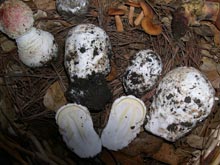
Coccora eggs and muscaria button |
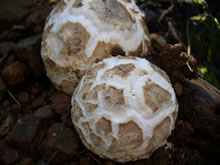 Areolate coccora eggs |
It can be far more difficult to identify these mushrooms in their egg stage. When young, all amanitas are covered by a membrane called a universal veil. In the case of the Coccora, this veil is extremely thick and cottony, and the top of the mushroom egg is wider than the bottom. When you slice the egg in half, top to bottom, you can see an outline, in a creamy yellow, of the embryonic mushroom. In the photo of the amanita eggs, you can see Coccora eggs both whole and sliced at the bottom of the basket, and a toxic Amanita muscaria button above them, that shows a base wider than its top. This characteristic, of the base wider than the top of the egg, also holds true for both deadly species of amanitas here in California.
The Fall version of the Coccora is one of the most commonly eaten West Coast amanitas. Italian Americans who collect this mushroom for the table say that it reminds them of the Caesar’s Amanita found in Italy. Caesar’s Amanitas are so well loved in Italy that towns have festivals in their honor. The Cocofungo Festival, named for the Caesar’s amanita, takes place in Italy in October, in the Treviso province. Apparently, despite its superficial resemblance to a Coccora, the Caesar’s is far superior in flavor.
The Fall Coccora of the Western states, in its classic golden brown form, resembles no other local amanita, poisonous or edible. But before even considering amanitas for the table, you should thoroughly familiarize yourself with our two local, deadly forms, Amanita phalloides and Amanita ocreata. Mushrooms come in many guises. “All that the Rain Promises, and more…,” by David Arora, is an excellent reference book for sharpening your identification skills with some of our more common Western species, with color photographs of mushrooms paired with a list of their distinguishing characteristics. The adage “collect many before you eat any” is particularly true for those who are considering eating amanitas. To be completely sure of your identification, each mushroom under your consideration should have ALL of the distinguishing characteristics of the species. It is also an excellent idea to have your ID checked by a local expert, especially the first few times that you collect it.
There is no room for error when considering amanitas for the table. Visiting a website or reading a book is insufficient information upon which to risk your life.
The spring form of the Coccora, a pale, cool-toned yellow or white, is not recommended for the table, since it can look uncomfortably like our deadly local amanitas, the white Amanita ocreata and the green-yellow Amanita phalloides.
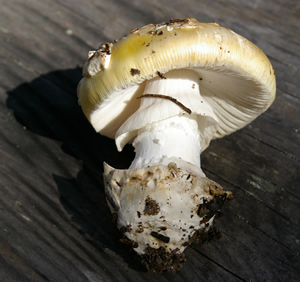
Amanita vernicoccora © photo by David Rust
There was an ongoing controversy about whether these two color phases of the Coccora were the same species, since their fruiting locations (coast vs. mountains) and time of fruiting (Fall vs. spring) differ. According to a number of experienced amanita eaters, they even tasted different. Preliminary DNA analysis from Dr. Anne Pringle’s lab at Harvard indicated that they were very closely related or possibly the same species. Recent DNA analysis and interpretation by Bojantchev et al, indicates they are two separate species. As of December 2011, the Spring Coccora was formally named Amanita vernicoccora.
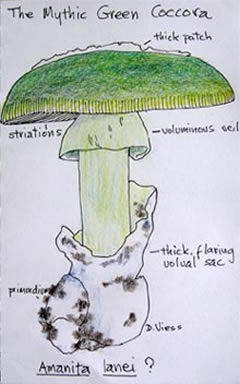
Drawing by Debbie Viess
A second Coccora controversy regards its Latin name. The late Dr. Lane of Oregon (for whom the mushroom was briefly named) was the first to describe a Fall Oregon amanita much like the Coccora, but green in all of its parts. I have never seen this color phase, nor has anyone else that I know of. If you have a first-hand report of a green Coccora, especially backed up with photos and/or voucher specimens, I would like to hear about it! If indeed this was an aberration, or a case of a color-blind initial description, then the name will eventually revert to Amanita calyptroderma, which was the first description of a classically-colored, Fall specimen from Santa Cruz.
Addendum December, 2011: The name Amanita calyptroderma was confirmed in Mycotaxon, Vol. 117., September, 2011.
Addendum August, 2009: According to both Index Fungorum and prominent North American amanitologists, the name Amanita lanei has been deprecated and the Fall Coccora is now back to being called Amanita calyptroderma.
© Debbie Viess
 back to top